Unlocking built environment opportunities in the green transition
Home
>Media Hub
>Unlocking built environment opportunities in the green transition
Unlocking built environment opportunities in the green transition
8 May 2026
This article was first published in The Edge Singapore City & Country on 8 May 2026.
The construction industry has been measured across three factors: cost, time and quality. “Today, there is a fourth metric, which is rapidly becoming just as important: carbon performance — and this changes everything,” says Farizan d’Avezac de Moran, board member of the Singapore Green Building Council.
Sustainability is no longer about the completed building, she adds, speaking at The Edge Singapore’s Sustainable Construction Symposium 2026 on April 29. “It is about how we design, procure, manufacture, assemble, operate and eventually, how we reuse the building. The future belongs to industries that can deliver all of this together successfully.”
The Singapore Green Plan 2030 was officially announced in 2021. According to Singapore’s Long-Term Low-Emissions Development Strategy, the aim is to halve emissions from their peak to 33 million metric tons of carbon dioxide equivalent (MtCO2e) by 2050, with a view to achieving net-zero emissions “as soon as viable” in the second half of the century.
The Singapore Green Building Masterplan (SGBMP) was first introduced in 2006 following the 2005 launch of the Building and Construction Authority (BCA) Green Mark scheme. The SGBMP has since been updated multiple times, with the fourth edition announced in 2021. As of the end of 2025, 66% of our buildings are green, 33% of new developments by gross floor area (GFA) are Super Low Energy (SLE) buildings and 72% have improved energy efficiency.
The SGBMP aims to deliver three key targets of “80-80-80 in 2030”: to green 80% of buildings by 2030, to certify 80% of new developments with the SLE standard from 2030 and to improve energy efficiency by 80% from 2005 for best-in-class buildings by 2030.
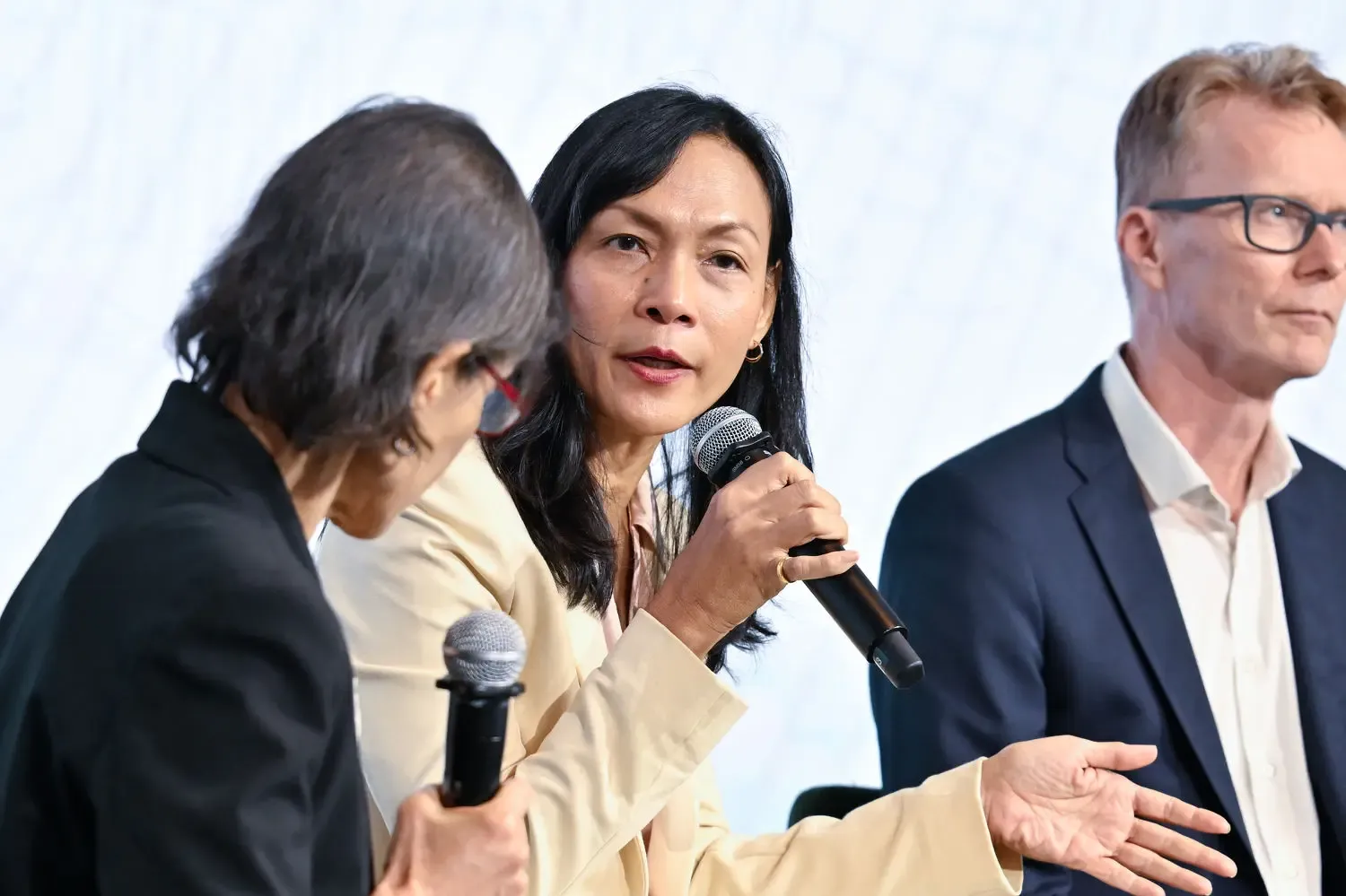
“Singapore already has the policy direction, we already have the ambition and we also already have the roadmap. The challenge now is the execution at scale,” says Farizan, outlining five important pillars in her presentation.
First, low-carbon planning and design are often decided before the construction starts. Hence, a building’s architecture, orientation, natural ventilation and other green features are all decided and locked in for decades.
Second is the high performance required of new buildings. Every new project built today should be future-ready — not just compliant today, but ready for the standards of 2030 and beyond.
Third, decarbonising existing assets could be trickier. “Most of the buildings that will exist in 2050 are already standing today. That means retrofits, upgrades, recommissioning, better controls and smarter asset strategies are essential,” Farizan indicates.
The fourth is embodied carbon and circularity. “This is the next frontier; steel, concrete finishes, waste, logistics, all of this matters as much as operational efficiency.”
The fifth factor is the Twixt system — a digital twin and smart technologies system. This is around BCA’s and SGBC’s emphasis on digital twins, smart building systems and smart analytics. These systems are used for real-time energy optimisation, predictive maintenance and data-driven, AI-enabled management to reduce carbon footprint.
Costs and opportunities
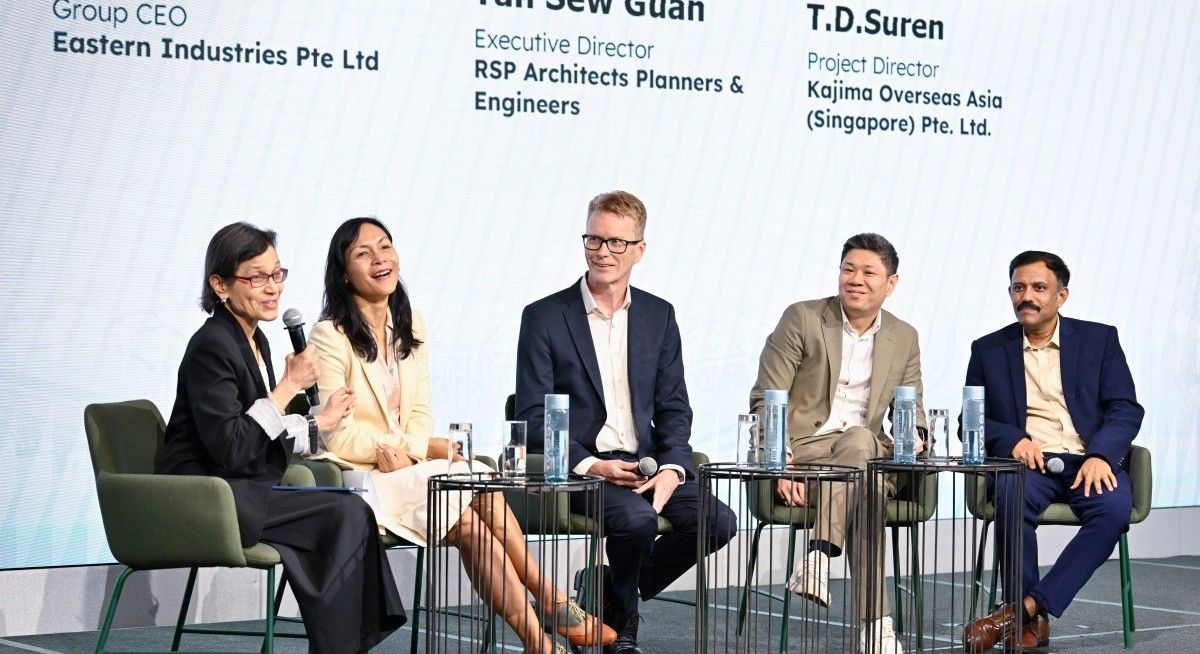
In a discussion following Farizan’s presentation, panellists explored the costs and opportunities arising from decarbonisation.
Concrete is still the most versatile construction method, says Matti Mikkola, group CEO, Eastern Industries.
“There are no real, good alternatives yet. That is what makes precast predominant here in Singapore. It is about less wastage and higher efficiencies. We have very good products that we design that utilise less concrete, less steel, within a very well-controlled production environment. We can concentrate on embodying less carbon and that obviously then also leads to durability, so building lifespan also increases,” he explains.
Eastern Industries has achieved the Singapore Environment Council’s Green Label certifications for reinforced concrete products, prestressed planks and hollow-core slabs, recognising its efforts to conserve the environment and support BCA’s sustainable construction agenda.
A certain number of sustainable features are expected of any new development, adds fellow panellist Tan Sew Guan, executive director, RSP Architects Planners & Engineers. “In terms of that, early collaboration with owners, designers, architects and builders plays a very important role. When you set your sustainability target, material choices, design and execution all play a very important role in achieving that target,” he adds.
Meanwhile, DfMA (Design For Manufacturing And Assembly) and IBS (Industrialised Building System) are strategies aimed at increasing efficiency in construction. DfMA is a design philosophy that focuses on designing components for ease of manufacture and assembly to reduce waste, cost and time. IBS is a construction technique where components are manufactured in a controlled factory environment (off-site) and transported to the site for installation.
Construction and engineering companies have encouraged the use of the two construction methods, says Kajima Corporation project director Dharmasurendranath Tharmasirirajah, who goes by Suren.
“Once you’ve started construction, it is pretty difficult to change [plans] halfway. Hence, we need to integrate both conventional and these modern DfMA methods in a way that benefits the projects,” says Suren. “For clients, the trade-off is that we will have excessive wastage and we will rely heavily on skilled manpower.”
Is a green building necessarily more expensive? According to Mikkola, almost all of the cement he manufactures is low-heat cement. Low-heat cement releases heat more slowly and in smaller amounts, significantly reducing peak temperature rise and temperature differentials, thereby reducing thermal cracking and ensuring long-term durability.
This type of cement is not any more expensive than normal OPC (Ordinary Portland Cement), says Mikkola. “The same thing has happened with, for example, manufactured sand, which we feel is a very, very important initiative, to stop using depleting natural sand. Once the volume is there, the producers of all of these materials will be able to produce them at the same cost. It just takes time to reach that. And if we’re all driving for the same target, the producers will follow. They will start producing what we want and the cost will come down. I don’t think there will be much of a difference [in cost].”
Another way to decarbonise is to reuse. In Europe, the trend is designing for disassembly. “We designed the building to be assembled and then once it comes to the end of its lifespan in that particular location, it can actually be unbolted and shifted and built elsewhere. The key thing is: you’re extending the building lifespan significantly, which, again, is such an important part of sustainability,” Mikkola says.
Better valuations?
Suren says greening existing buildings is about introducing hybrid cooling, passive cooling, AI-driven heating, ventilation and air-conditioning (HVAC) systems and DfMA installations. “Recently, I read an article that the brown discount is real, so these initiatives are helping the industry,” he points out.
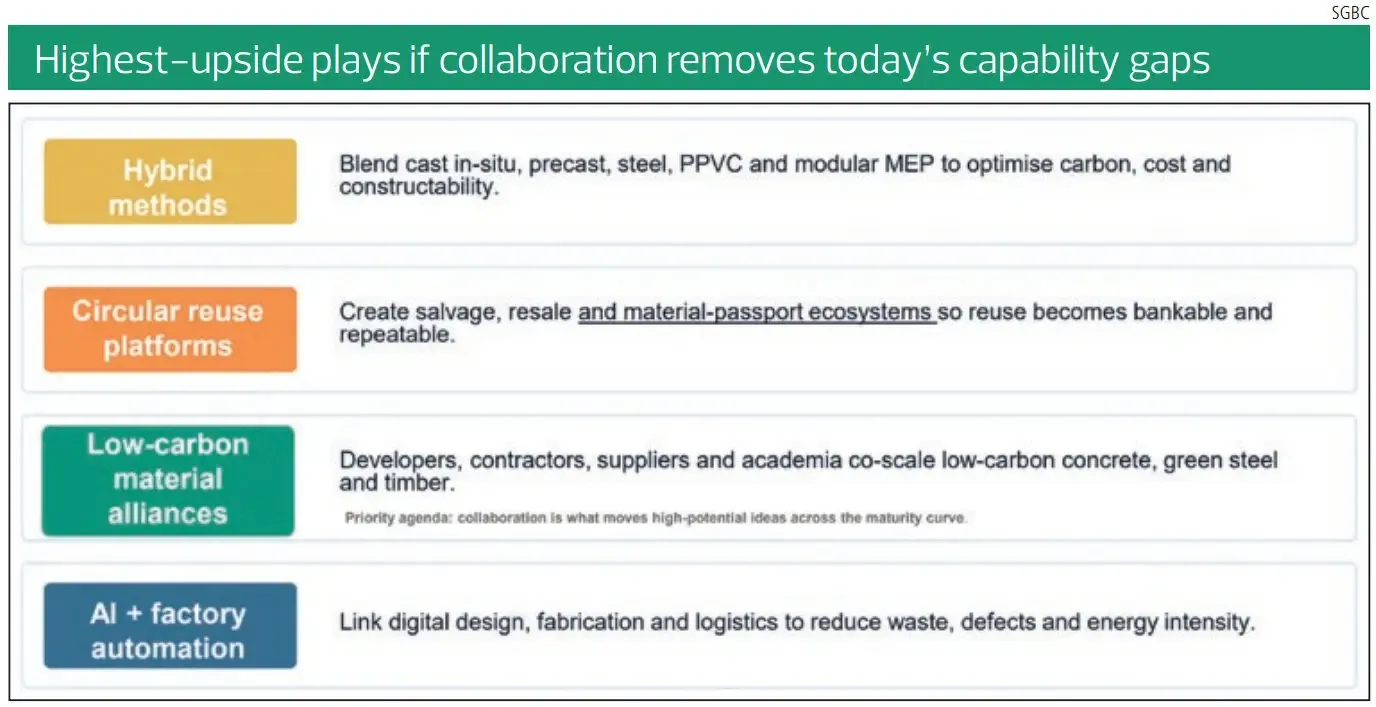
According to Mikkola, green buildings will be more durable than brown buildings and will last longer. “Secondly, the operating costs of such a building will be lower, so your installations are better, your operational costs will be lower and green buildings will have a higher value,” he elaborates.
Since the valuation of investment properties depends on rents, rental outlook, occupancy and tenant quality, landlords who are asked to green their buildings often wonder whether green features can be included in the building’s valuation.
Farizan says there is a line item in the discounted cash flow (DCF) spreadsheet on whether the building has received green building certifications. The value will say yes or no.
The valuation of the specific building could also depend on the certifications it has received. “What I see quite often in the valuation of buildings and assets is that they never ask the next question: Will the certification expire next month? I think valuers should consider that. If the certification is not going to be prolonged, then the valuation should be lower. So at the end of the day, it is how the formula all adds up to the valuation of the building,” says Farizan.
In sum, green buildings attract better tenants, have better cash flow and are operationally cheaper to run.
Return to Media Hub
|
Search More Articles
About Us
Malayan Cement Berhad (MCB) is the Malaysian operations of YTL Cement Group and the country’s leading building materials company. As part of a regional Group committed to helping you build better, MCB provides an integrated suite of high-performance materials and sustainable environmental services that support construction of all scales – from homes to major infrastructure.
With a legacy that spans more than 70 years, MCB operates integrated cement plants in five locations, four grinding plants, three cement terminals, two depots and over 50 ready-mixed concrete batching plants two drymix plants, three aggregate quarries, and a dedicated R&D facility – the Construction Development Lab.
MCB offers a full range of building solutions, including cement, clinker, ready-mixed concrete, drymix, and quarry products, all designed to meet the evolving needs of the Malaysian market. The company also delivers sustainable innovations such as its ECO Product Range and offers environmental services.
With a fleet of over 1,500 trucks covering more than 120,000 kilometres daily, MCB ensures efficient and reliable delivery to customers across Peninsular Malaysia. Its scale, operational reach, and long-standing experience position it as a key partner in nation building.
MCB offers a full range of building solutions, including cement, clinker, ready-mixed concrete, drymix, and quarry products, all designed to meet the evolving needs of the Malaysian market. The company also delivers sustainable innovations such as its ECO Product Range and offers environmental services.
With a fleet of over 1,500 trucks covering more than 120,000 kilometres daily, MCB ensures efficient and reliable delivery to customers across Peninsular Malaysia. Its scale, operational reach, and long-standing experience position it as a key partner in nation building.
Copyright © 2026 Malayan Cement Berhad [195001000048(1877-T) | All rights reserved.
Aduan
